

Arabic Classes for Kids
Learning Arabic as a child isn’t about memorizing grammar rules — it’s about building a natural connection to the language of the Quran, early enough that it never feels foreign.
“Indeed, We have sent it down as an Arabic Qur’an that you might understand.”
— Surah Yusuf 12:2
Children who grow up with even a basic feel for Arabic vocabulary and structure carry that foundation for life — the same way a child who hears a second language at home absorbs it more naturally than an adult studying it later.
Why Start Arabic Young
Language acquisition genuinely works differently for children than adults. A young child’s brain is naturally wired to absorb new sounds, vocabulary, and sentence patterns with far less conscious effort than an adult relearning the same material. This isn’t a marketing claim — it’s a well-documented pattern in how children acquire language generally, and it applies to Arabic exactly as it does to any other language.
Arabic classes for kids take advantage of this natural window. Rather than waiting until a child is old enough to sit through formal grammar instruction, starting earlier — even with simple vocabulary and letter recognition — builds intuitive familiarity that makes later, more structured learning significantly easier. Parents sometimes worry that starting “too early” wastes a young child’s time on content they won’t remember, but the goal at this stage isn’t retention of specific facts — it’s building comfort with unfamiliar sounds and letter shapes, which pays off measurably later even if a four-year-old can’t recite what they learned last month.
At What Age Should a Child Start Arabic Classes?
Most children can begin simple Arabic exposure — letters, basic vocabulary, short phrases — as early as three or four years old, similar to how arabic classes for toddlers typically work: short, playful, low-pressure sessions rather than formal instruction. More structured lessons, including reading and basic grammar, generally suit children from around five or six years old onward, once attention span and comfort with structured sessions has developed further.
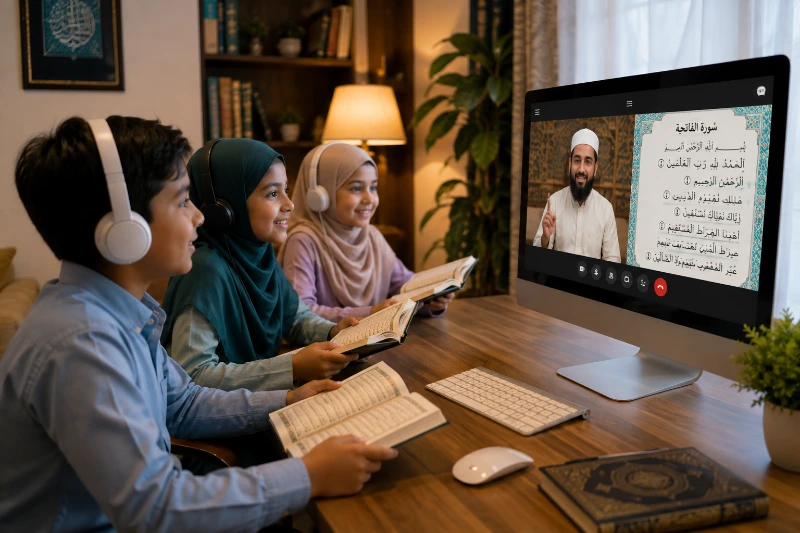
Building Comfort Early
A young child’s brain absorbs new sounds and patterns with far less conscious effort than an adult relearning the same material.
What Arabic Classes for Toddlers Actually Look Like
For the youngest learners, arabic classes for toddlers look nothing like a typical classroom lesson. Sessions are short — often ten to fifteen minutes — and built around repetition, simple vocabulary, and warm, patient interaction rather than any formal curriculum. The goal at this age isn’t fluency; it’s comfort and familiarity, planting the earliest seeds of recognition that make later structured learning feel natural rather than foreign.
How Do You Keep a Toddler’s Attention During an Arabic Lesson?
Very short, simple sessions work best — repetition of a few words, simple songs or rhymes, and genuine warmth from the teacher matter far more than structured content at this age. A toddler who associates Arabic learning with a pleasant, unhurried few minutes each week is building the right foundation, even if very little “formal” content is covered in any single session.
A Clear Learning Progression
From letter recognition to simple reading to real comprehension — each stage builds on the last.
What Older Children Learn in a Structured Arabic Class for Kids
Once a child is ready for more structured learning, a genuine program moves through a clear progression:
Alphabet Recognition
Letter shapes, sounds, and how letters connect within words.
Basic Vocabulary
Starting with words that appear frequently in daily life and in the Quran.
Simple Reading Practice
Moving from individual letters to short words and phrases.
Quranic Vocabulary Connection
Building bridges between everyday Arabic and words your child already hears in Quran lessons.
This progression mirrors, and deliberately reinforces, what a child may already be learning in Noorani Qaida or early Quran reading lessons. See our Noorani Qaida program and Quran classes for kids for how these connect.
How Is an Arabic Class for Kids Different from a Regular Quran Lesson?
They’re related but distinct. A Quran lesson focuses on reading and reciting the Quranic text itself, with Tajweed accuracy as the priority. An arabic class for kids focuses more broadly on the language — vocabulary, meaning, sentence structure — building comprehension rather than only correct recitation. Many families find the two work best together: Quran lessons build correct reading and recitation, while Arabic language lessons build the understanding of what those words actually mean.
Will Learning Arabic Help My Child with Their Quran Lessons Too?
Significantly, yes. A child who recognizes Arabic vocabulary and basic sentence patterns often progresses faster in Quran reading and Tajweed, since the letters and sounds are no longer entirely unfamiliar. The two subjects reinforce each other naturally, which is why many families choose to run Arabic classes for kids alongside, rather than instead of, Quran lessons.
The Same Teacher, Every Week
Young children take several sessions to feel comfortable with a new adult — consistency genuinely speeds up progress.
One Consistent, Qualified Teacher — Not a Rotating Staff
Classes are taught personally by Mufti Shahbaz Hussain, whose classical Arabic training through Dars-e-Nizami and a decade of teaching experience mean your child is learning from someone with genuine scholarly grounding in the language — not simply a native speaker without formal teaching training.
Just as importantly, your child learns from the same teacher every week, building real familiarity and comfort over time rather than adjusting to a new, unfamiliar tutor every few sessions. This consistency matters especially for young children, who often take several sessions just to feel fully comfortable with a new adult — restarting that process repeatedly with different tutors genuinely slows progress in a way that’s easy to underestimate until you’ve experienced it firsthand.
Is It Better for My Child to Learn Arabic and Quran with the Same Teacher?
Many families find real value in this. When one teacher handles both Arabic classes for kids and Quran lessons, that teacher can connect the two subjects naturally, reinforcing vocabulary and pronunciation across both rather than teaching them as entirely separate, disconnected subjects.
Start with a Free Trial Class
See exactly how your child responds to a real lesson — warmth, pacing, and teaching style — before committing to anything.
Related Programs

Meet Your Teacher, Mufti Shahbaz Hussain
Classes are taught personally by Mufti Shahbaz Hussain — Hifz, Qirat, Dars-e-Nizami, and Mufti Course, with a specialization in Islamic Business & Finance and Islamic Economics, and 10 years of teaching experience. View his verified credentials.
Frequently Asked Questions
What age is right for arabic classes for kids?
Simple exposure can begin as early as three or four years old through short, playful sessions. More structured lessons with reading and basic grammar typically suit children from around five or six years old onward.
Are arabic classes for toddlers really effective, or too early to matter?
Yes, though effectiveness at this age looks different than for older children — the goal is comfort and early familiarity with sounds and simple vocabulary, not fluency. This groundwork genuinely makes later structured learning easier.
How much do online arabic classes for kids cost?
Pricing depends on lesson frequency and length. Contact us for our current rates.
Can my child learn Arabic without any prior exposure to the language at home?
Yes. Most children starting this kind of program have no prior exposure, and lessons are structured to build from zero, the same way Quran lessons for beginners do.
Do Arabic lessons for kids include any Islamic content, or is it purely language-focused?
Vocabulary is often drawn naturally from everyday Islamic context and Quranic terms, connecting language learning with your child’s broader Islamic education, though the core focus remains building genuine Arabic language skill.
