
Tajweed Quran: Learn to Recite Correctly, One Letter at a Time
Reciting tajweed quran correctly isn’t a bonus skill — it’s the difference between reading the Quran and accidentally changing what it says. Here’s what that actually means, and how it’s properly taught.
“And recite the Qur’an with measured, deliberate recitation.”
— Surah Al-Muzzammil 73:4
That single verse is the entire foundation of Tajweed. Allah didn’t just instruct the Prophet ﷺ to recite the Quran — He specified how: slowly, deliberately, with care for every letter. Tajweed is simply the codified science of fulfilling that instruction correctly, letter by letter, rule by rule.
What Is Tajweed, and Why Does One Wrong Letter Actually Matter?
Tajweed quran means reciting the Quran exactly as it was revealed — with each Arabic letter pronounced from its correct articulation point (Makharij), with the correct duration, emphasis, and characteristics. This isn’t a stylistic preference. Arabic is a precise language where changing a single letter, or holding a vowel sound for the wrong length, can genuinely change the meaning of a word.
A commonly cited example: the letter ق (Qaf) and ك (Kaf) are pronounced from different points in the throat. Mispronounce one as the other in certain words, and you’re no longer saying the word that was revealed — you’re saying a different word entirely, sometimes with a meaning that has nothing to do with the verse. This is exactly why tajweed quran instruction exists as its own dedicated field of study, distinct from simply “reading Arabic.”
Can Tajweed Mistakes Really Change the Meaning of a Verse?
Yes, in specific, well-documented cases — and this is precisely why self-teaching from an app or a YouTube video, without a live teacher listening and correcting you, carries real risk. A teacher who can hear the specific mistake you’re making and correct it before it becomes a permanent habit is not a luxury; it’s the actual mechanism by which tajweed quran is preserved correctly from one generation to the next, exactly as it has been since the Quran was revealed.
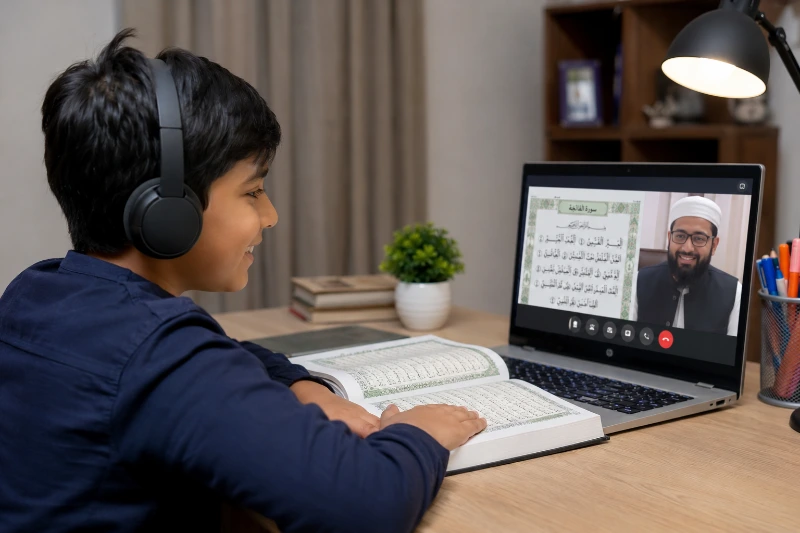
Precision, Rule by Rule
Tajweed is a precise, structured discipline — every rule fits together like a system, built piece by piece until correct recitation becomes second nature.
What You’ll Actually Learn in Our Online Tajweed Classes
Learning to recite quran with tajweed correctly isn’t one skill — it’s a structured sequence of rules, each building on the last. Here’s what a properly structured tajweed quran curriculum actually covers:
- Makharij (articulation points) — exactly where each of the 29 Arabic letters originates in the mouth or throat, and how to pronounce each one precisely
- Sifaat (letter characteristics) — the qualities that distinguish similar-sounding letters from one another
- Fathah, Kasrah, Dhammah — the three short vowel sounds and how they change pronunciation
- Madd (prolongation) — when and how long to elongate a sound, including Madd Asli, Madd Muttasil, Madd Munfasil, and Madd Laazim
- Ghunnah (nasalization) — the nasal sound applied to specific letters in specific positions
- Noon Saakin and Tanween rules — Idhaar, Ikhfa, Iqlab, and Idghaam, which govern how these sounds change depending on what follows them
- Qalqalah — the distinctive “bouncing” sound applied to five specific letters when they carry a Sukoon
- Tafkheem and Tarqeeq — heavy versus light letter pronunciation, including the specific rules for the letter Raa and for Allah’s name depending on context
- Waqf (stopping rules) — where and how to pause correctly during recitation without disrupting meaning
This is not a simplified overview. Every one of these rules is taught individually, with live correction, until it becomes second nature — not memorized as theory, but internalized as a habit in your actual recitation.
How Long Does It Actually Take to Learn Quran with Tajweed?
There’s no single honest answer, because it depends entirely on your starting point and how many lessons per week you attend. A student who already reads Arabic fluently but needs to refine specific Tajweed rules might see solid progress within a few months. A complete beginner starting from Noorani Qaida before layering in Tajweed rules should expect a longer, more gradual path — commonly six months to a year of consistent lessons. What predicts success isn’t natural talent; it’s showing up consistently and practicing between sessions.
Learn From the Comfort of Home
No commute, no rigid weekend schedule — just a calm, consistent lesson at the same time each week, wherever you are in the USA.
Taught by a Qualified Qari — Not Just a Fluent Reader
Anyone can read Arabic quickly. Reciting tajweed quran correctly is a different, more rigorous skill — and it requires a teacher who has formally studied Qirat, the science of Quranic recitation itself, not simply someone who grew up hearing the Quran recited.
Classes at Al Hussain Islamic Institute are taught personally by Mufti Shahbaz Hussain, who holds a formal qualification in Qirat as part of his broader scholarly training — alongside Hifz (complete Quran memorization), Dars-e-Nizami, and a completed Mufti Course. This matters specifically for Tajweed instruction: Qirat is the dedicated discipline of correct Quranic recitation, and a teacher who has formally studied it is qualified to hear subtle articulation errors that an untrained ear would miss entirely, and to explain precisely why a rule applies rather than simply reciting it from memory.
Do I Need a Live Teacher, or Can I Learn Tajweed from an App?
Apps and recorded videos can help with listening practice and repetition, but they cannot hear you. Tajweed correction is fundamentally a two-way skill — your teacher listens to your specific recitation, in real time, and corrects the exact letter or rule you’re getting wrong before it becomes a permanent habit. This is the entire reason live, one-on-one instruction produces measurably better results than passive or self-paced learning for this specific skill.
Is Tajweed the Same Thing as Qirat?
They’re closely related but not identical. Tajweed refers to the set of pronunciation rules themselves — the “how” of correct recitation. Qirat is the broader, more advanced science of Quranic recitation, including the study of the different authentic transmitted recitation styles of the Quran. In practice, a teacher who has formally studied Qirat has necessarily mastered Tajweed at a deep level first, since Tajweed is the foundation Qirat is built on. This is why a Qirat-qualified teacher is especially well suited to teaching Tajweed accurately, rather than only reciting correctly without being able to explain the underlying rule.
A Program Built Around Your Family
Whether it is a child, a parent, or a grandparent learning to recite correctly, lessons are shaped around who is actually sitting down to learn.
Who This Course Is For
Tajweed instruction isn’t one-size-fits-all, and the pace and framing genuinely differ by student:
Children
Learning tajweed quran for the first time need patience, repetition, and simple explanations before technical terminology. See our Quran classes for kids.
Adult Beginners
Including reverts to Islam, often need to start from Arabic letter recognition itself before Tajweed rules make sense — and that’s completely normal. See our Quran classes for adults.
Already-Reading Students
Students who already read Arabic but want to correct specific habits or formally learn quran with tajweed for the first time can move faster, focusing directly on rule-by-rule correction.
Hifz Students
Benefit enormously from strong Tajweed foundations before or alongside memorization — reciting correctly from the start prevents having to unlearn bad habits later. See our Hifz program.
Is Tajweed Taught Differently for Kids Than for Adults?
The rules themselves don’t change — Tajweed is Tajweed regardless of age. What changes is teaching style. Children generally need shorter lessons, more repetition, and simpler language before technical terms are introduced. Adults can usually move through the terminology faster but may need more patience with themselves, especially if they feel self-conscious learning something “for the first time” later in life. A good teacher adjusts pace and explanation style to the student, not the other way around.
Start with a Free Trial Class
Before committing, sit in on a real trial lesson and hear how Tajweed rules are explained — not a sales pitch, an actual short lesson where you can ask questions directly and evaluate the teaching style for yourself.
Consistency Turns Into Confidence
Small, steady weekly sessions compound into real, lasting recitation skills — the same way any home habit becomes second nature over time.
Related Programs

Meet Your Teacher, Mufti Shahbaz Hussain
Classes are taught personally by Mufti Shahbaz Hussain — Hifz, Qirat, Dars-e-Nizami, and Mufti Course, with a specialization in Islamic Business & Finance and Islamic Economics, and 10 years of teaching experience. View his verified credentials.
Frequently Asked Questions
What exactly is Tajweed, and why is it necessary?
Tajweed is the set of precise rules governing correct Quranic pronunciation — where each letter is articulated, how long vowels are held, and how sounds change depending on context. It’s necessary because Arabic pronunciation errors can change the actual meaning of words in the Quran, so reciting with tajweed quran accuracy preserves the text exactly as it was revealed.
How can I learn Quran online with Tajweed as a complete beginner?
Start with Noorani Qaida to build Arabic letter recognition and basic pronunciation, then move into structured Tajweed rules with a live teacher who corrects you in real time. This sequence works for both children and adult beginners.
What are typical costs for one-on-one online Tajweed lessons?
Pricing varies by academy and lesson frequency. Contact us for our current rates and available schedules.
Can I join online Quran classes specifically to learn Tajweed if I already know how to read Arabic?
Yes — many students already read Arabic but want to refine specific pronunciation habits or formally learn quran with tajweed for the first time. Lessons can focus directly on rule-by-rule correction rather than starting from letter recognition.
How do I access my scheduled online Tajweed class?
Classes are conducted over a simple live video call at your scheduled time — no special software required beyond what you likely already use for video calls.
