
Noorani Qaida Online Classes at Home
Before a single verse of the Quran is opened, there’s a foundation that has to be built first — and rushing this stage is the single most common reason students struggle with Tajweed later.
“Read! In the name of your Lord who created.”
— Surah Al-Alaq 96:1
The very first word revealed in the Quran was a command to read. Noorani Qaida is where that instruction actually becomes possible for a new reader — the structured starting point that makes everything that follows readable.
What Noorani Qaida Actually Is, and Why It Can’t Be Skipped
Noorani Qaida is a foundational primer that teaches Arabic letter recognition, correct pronunciation (Makharij), basic vowel sounds, and the earliest building blocks of Tajweed — before a student ever opens the Quran itself. It has been the traditional starting point for new Quran readers for generations, for a simple reason: skipping it and jumping straight into Quranic text tends to produce readers who can technically sound out words but mispronounce letters in ways that quietly become permanent habits.
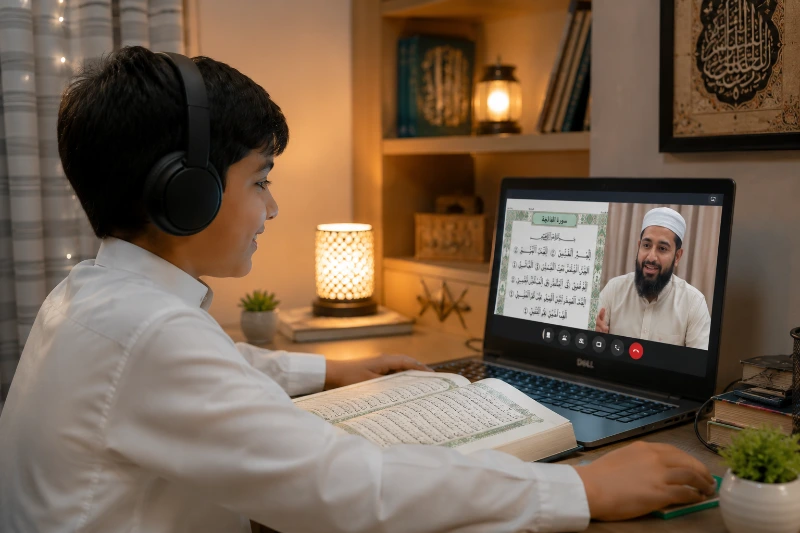
Noorani qaida online classes at home deliver exactly this same traditional foundation, just without needing a physical classroom or a nearby teacher. The content and rigor don’t change simply because the lesson happens over video instead of in person — what matters is a teacher who corrects every mispronunciation as it happens, which live online instruction does just as effectively as a room does. For families juggling school pickups, work schedules, and weekend commitments, noorani qaida online classes at home also remove an entire layer of logistics that often delays a child’s — or an adult’s — start with Quran reading by months or years longer than necessary.
Why Do Some Students Skip Noorani Qaida, and What Happens When They Do?
Understandably, some students — especially adults eager to start reading the Quran itself — want to bypass this stage as an unnecessary delay. In practice, skipping it usually backfires: mispronunciations that would have been caught and corrected in Noorani Qaida instead get baked into a student’s reading habits, requiring far more time to unlearn later than the foundational stage would have taken in the first place.
A Foundation That Can’t Be Rushed
Skipping this stage usually backfires — mispronunciations get baked in and take far longer to unlearn later.
How to Learn Noorani Qaida Online, Step by Step
A structured path to learn noorani qaida online typically moves through clear, sequential stages:
Letter Recognition
All 29 Arabic letters, their shapes, and correct pronunciation points.
Letters with Short Vowels
Fathah, Kasrah, and Dhammah, and how each changes a letter’s sound.
Joined Letters
Recognizing how letter shapes change depending on their position within a word.
Basic Tajweed Introduction
Early rules like Sukoon and simple Madd, laying groundwork for full Tajweed study later.
This sequence is deliberate. Each stage exists because it builds a specific skill the next stage depends on — rushing ahead before a stage is solid tends to create gaps that resurface later, usually at a more frustrating point in a student’s Quran reading journey.
Can I Learn Noorani Qaida Online at My Own Pace, or Is There a Fixed Schedule?
Pace is entirely individualized. Some students move through the full sequence in a few weeks; others, particularly young children or adults with limited weekly time, take several months. There’s no fixed universal schedule, and a good teacher will adjust pacing based on how solidly each stage is actually mastered — not simply move forward on a calendar regardless of readiness.
What Is Noorani Qaida Lesson 5, and Why Do Parents Ask About It Specifically?
Lesson numbering varies slightly between different Noorani Qaida editions and teachers, but noorani qaida lesson 5 commonly corresponds to a stage introducing joined letters or early short-vowel combinations — a point where many students, especially children, hit their first real challenge after the relatively straightforward early lessons. If your child seems to be moving more slowly around this stage, that’s a very common pattern, not a sign of difficulty with the material overall.
Patient, Foundational Teaching
Repetition without frustration, correction without discouragement — a distinct skill from advanced scholarly instruction.
Taught with the Patience This Foundational Stage Requires
Noorani Qaida instruction demands a particular kind of teaching patience — repetition without frustration, correction without discouragement, especially for young children encountering unfamiliar letter shapes and sounds for the first time. Classes are taught personally by Mufti Shahbaz Hussain, whose ten years of teaching experience specifically include Noorani Qaida instruction as a core, recurring part of his work — not an occasional beginner add-on to more advanced teaching.
This matters because foundational teaching is its own skill, distinct from advanced scholarly instruction. A teacher deeply experienced in advanced Tafseer or Fiqh isn’t automatically well suited to patiently guide a five-year-old through their first Arabic letters — but Mufti Shahbaz Hussain’s teaching background covers both ends of that spectrum directly.
Is Noorani Qaida Only for Children, or Do Adults Need It Too?
Adults benefit from it just as much as children, and there’s no reason for adult beginners to feel it’s “beneath” their level. Any student — regardless of age — who cannot yet confidently recognize Arabic letters and their correct pronunciation benefits from this same structured foundation. Many adult beginners specifically prefer noorani qaida online classes at home precisely because it lets them build this foundation privately, without any self-consciousness about starting from the very beginning later in life.
Set Up at Home in Minutes
A device, a quiet space, and a Noorani Qaida book — that’s really all it takes to begin.
What You’ll Need to Get Started
- A tablet, laptop, or smartphone with a stable internet connection
- A quiet space with minimal distractions
- A Noorani Qaida book or PDF, which your teacher can help you access if you don’t already have one
- Consistency — short, regular sessions build this foundation far more effectively than occasional long ones
Do Noorani Qaida Online Classes at Home Work for Multiple Siblings at Once?
Each child benefits most from individual, one-on-one sessions rather than sharing a single class slot, since siblings are almost always at different stages and different paces even close in age. That said, scheduling noorani qaida online classes at home for multiple siblings back-to-back on the same day is entirely possible and something many families with more than one child find genuinely convenient.
Start with a Free Trial Class
See exactly how patient, structured Noorani Qaida instruction actually looks — for yourself or your child — before committing to anything.
Related Programs

Meet Your Teacher, Mufti Shahbaz Hussain
Classes are taught personally by Mufti Shahbaz Hussain — Hifz, Qirat, Dars-e-Nizami, and Mufti Course, with a specialization in Islamic Business & Finance and Islamic Economics, and 10 years of teaching experience. View his verified credentials.
Frequently Asked Questions
What is the Noorani Qaida curriculum?
It’s a structured foundational course covering Arabic letter recognition, correct pronunciation, short vowels, joined letters, and early Tajweed concepts — the essential groundwork before reading the Quran itself.
What are the benefits of learning Noorani Qaida online specifically?
It removes the need for a local teacher or physical classroom while preserving the same rigor — live correction of every mispronunciation, the same as in-person instruction, without geographic limitations.
How long does it take to complete Noorani Qaida?
This varies by age and consistency, but most students complete the full sequence within a few months of regular, weekly lessons — faster for adults with strong existing focus, sometimes longer for young children needing more repetition.
Is Noorani Qaida different for adults versus children?
The content is the same, but teaching pace and style differ — children typically need shorter sessions with more repetition and patience, while adults can often move somewhat faster once they commit to consistent practice.
How much do noorani qaida online classes at home cost?
Pricing depends on lesson frequency and length. Contact us for our current rates.
